


 Grappling and wrestlingGrappling Gear, Piece by Piece, and What the Rules Say
 What Is a Rash Guard and What Is It For in Combat Sports?
 5 Reasons to Wear a Rash Guard in Combat Sports
 Can You Run in a Rash Guard?


Pick a size
Size GuideFree shipping from $80
The Rashu magazine for combat sports: guides, disciplines, tips.
All Articles Grappling and wrestling · 4 min read
Grappling Gear, Piece by Piece, and What the Rules Say
Rashu / SHIAI / Buying guides
A rash guard is a tight-fitting, stretch top worn directly on the skin in BJJ, grappling, wrestling, and MMA. It protects the skin from mat burn, limits direct contact with the mat and a partner's sweat, and gives nothing to grab. You'll also see it written "rashguard" as one word, or called a "lycra" in some clubs. Here's what to know before choosing one.
 By Romain Brunel
Updated on November 6, 2026
5 min read
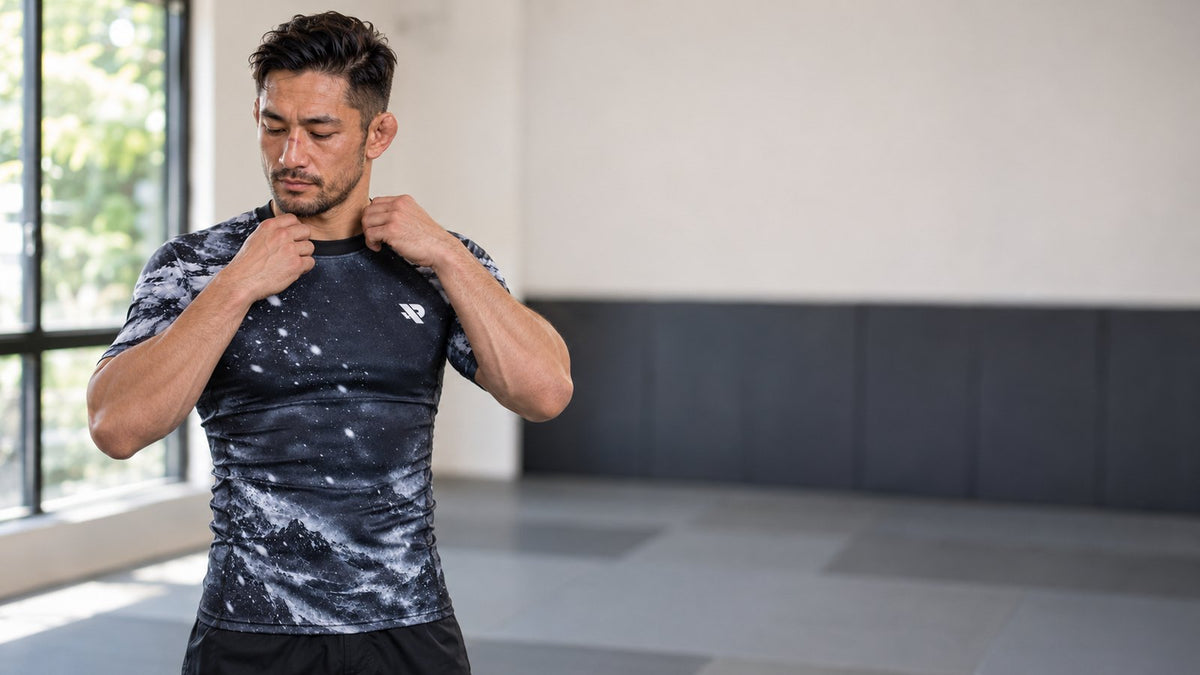
On the ground, skin rubs constantly against the mat and against your partner. Elbows, shoulders, and forearms take mat burn and scrapes. A rash guard acts as a shield: the fabric slides where skin would catch.
A whole club rolls across the same mat every night. A rash guard reduces the surface of skin exposed to the mat and to other people's sweat. It doesn't replace basic hygiene (showering, short nails, covered cuts, gear washed after every session), but it adds to it.
In no-gi, grabbing clothing isn't allowed. A loose t-shirt still gets caught under an arm or in a hand. A well-fitted rash guard sticks to the body: there's nothing to grab, nothing that rides up over your face during a sweep.
Polyester barely absorbs water. Sweat passes through the fabric and dries fast, where cotton soaks it up and gets heavy. Elastane follows every movement without restricting the shoulders or hips.
| Criterion | What to look for | Why |
|---|---|---|
| Fabric weight | Around 230 g/m² | Thick enough to last and stay opaque, thin enough to breathe |
| Material | Polyester and elastane (around 85/15) | Fast drying, elastic recovery, lasting shape |
| Stretch | 4-way stretch | The fabric follows width and length, with no pull at the shoulders |
| Seams | Flat | No extra thickness rubbing against the skin |
| Dyed into the fibre | The ink enters the fibre: no cracking, no peeling design | |
| Body length | Down to the shorts' waistband or below | It won't ride up during rolls, and it's required in IBJJF competition |
Rashu rash guards are cut from a 230 g/m² fabric, with 4-way stretch, flat seams, and a design dyed into the fibre.
The two look alike: same fabric family, same close-to-body cut. At Rashu, they don't play the same role.
In short: if you're stepping onto a mat, get a rash guard. If you want a discreet base layer for weightlifting or cardio, get a compression top.
| Discipline | Our advice |
|---|---|
| No-gi BJJ and grappling | Long sleeves to protect the forearms and make arm grips harder; short sleeves if you run hot |
| MMA | Short sleeves: mandatory in amateur MMA (above the elbow) |
| Wrestling | Short or long sleeves, depending on the tournament rulebook |
| Under the gi (women) | Short or long sleeves, no colour rule |
To go further on BJJ, read our guide to choosing a jiu-jitsu rash guard.
A rash guard illustrated across the whole surface is therefore perfect for training, ADCC, and most opens, but not for IBJJF no-gi. Always check the rulebook of the tournament you're entering before signing up.
Sources: IBJJF uniform rules, ADCC uniform FAQ, UWW rules, reviewed on 2026-10-23.
Full detail is on the rash guard care page.
If you spend time on the ground, a rash guard isn't optional: it's your work gear. Get it fitted, long enough, in a sturdy fabric with flat seams, with a design dyed into the fibre. And save the compression shirt for the gym.
Both are used. The term comes from the English "rash guard", literally a guard against rashes. It's often written as one word, "rashguard", and called a "lycra" in some clubs.
No, it's worn directly on the skin. Women often add a sports bra underneath.
In no-gi, yes: the rash guard and shorts (or spats) make up the whole kit. In gi BJJ, it's worn underneath, and only mandatory for women in IBJJF competition.
Years of training if it's washed cold, with no fabric softener, and air dried. Heat is its 1st enemy: it wears out the elastane.
Yes, but a plain compression top is often better suited. We compared the two in our article on running in a rash guard.
Rash guard, shorts, and spats: grappling gear piece by piece, and what the IBJJF, ADCC, and UWW rulebooks require.
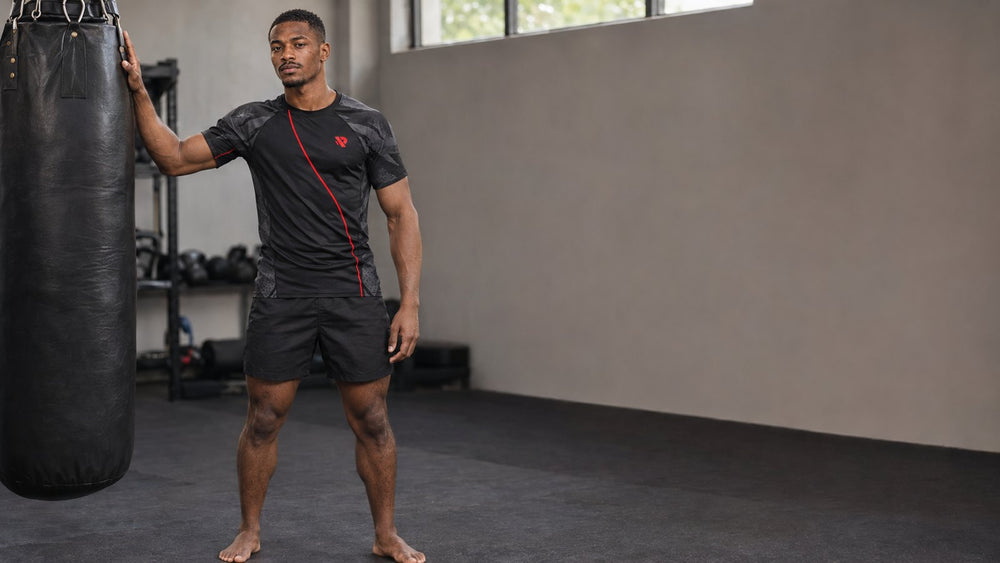
Skin, hygiene, training partners, movement, and rules: 5 concrete reasons to wear a rash guard in BJJ, grappling, and MMA.
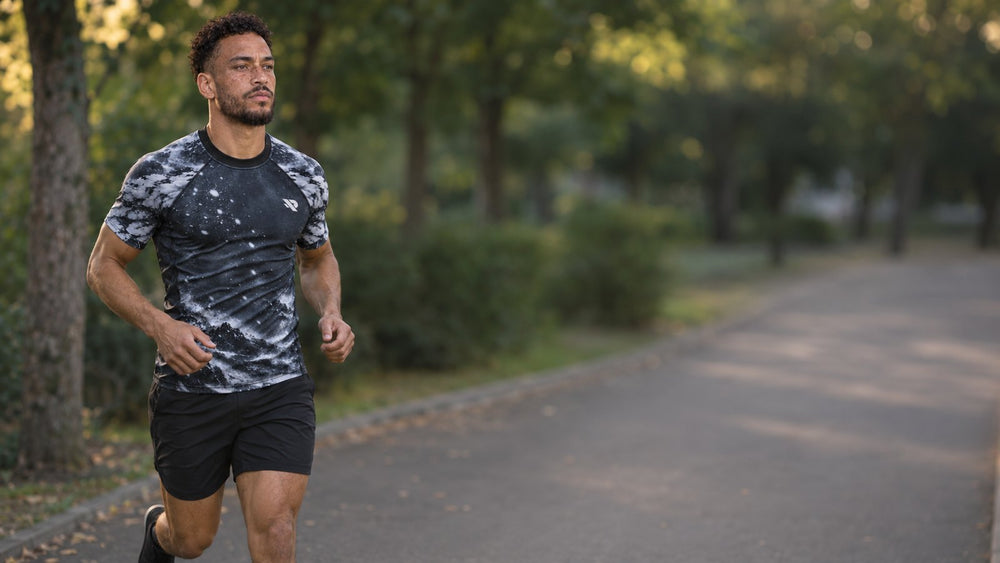
A rash guard works for running, but that's not what it's built for. What it brings, its limits, and the better alternative.
Rashu uses analytics and advertising cookies. You can accept or decline them. Learn more


 Clan Banners Short-Sleeve Rash Guard - Men
 Hexagon Short-Sleeve Rash Guard - Men
 Hexagon Long-Sleeve Rash Guard - Men
 Urban Graphite Camo Short-Sleeve Rash Guard - Men