


 Grappling and wrestlingGrappling Gear, Piece by Piece, and What the Rules Say
 What Is a Rash Guard and What Is It For in Combat Sports?
 5 Reasons to Wear a Rash Guard in Combat Sports
 Can You Run in a Rash Guard?


Pick a size
Size GuideFree shipping from $80
The Rashu magazine for combat sports: guides, disciplines, tips.
All Articles Grappling and wrestling · 4 min read
Grappling Gear, Piece by Piece, and What the Rules Say
A good BJJ rash guard hugs the body without squeezing, extends below the shorts' waistband, dries fast, and leaves nothing to grab. Choosing one comes down to 5 points: fit, fabric, print, your tournament's rules, and size. Here's how to judge each one, in no-gi and under the gi alike.
 By Romain Brunel
Updated on November 6, 2026
5 min read
Click a criterion to jump to its section.
In BJJ, the rash guard works on the mat: it slides, gets pulled, and rides up during sweeps and transitions. 3 details make the difference.


Men's and women's cuts aren't the same: the women's cut is fitted at the chest and hips. See the women's rash guards and the men's rash guards.
| Point | Benchmark | What to avoid |
|---|---|---|
| Weight | About 230 g/m² | Fabrics too thin, which turn see-through once stretched |
| Composition | Polyester and elastane, about 85/15 | Cotton, which soaks up sweat and gets heavy |
| Stretch | 4-way | 2-way fabrics that pull at the shoulders |
| Seams | Flat | Thick seams that chafe under the arms |
At Rashu, rash guards are 84% polyester and 16% elastane, 230 g/m², with flat seams. In short: a fabric dense enough not to turn see-through when stretched across the back, flexible enough to follow a high guard.


This is the point most buyers overlook, and the one that decides how long the design lasts.
The ink turns to gas and enters the polyester fiber before the seams are sewn. The design stretches with the fabric, doesn't crack, and doesn't peel.
The design is glued on top. It stays rigid, cracks when the fabric stretches, and eventually peels off in the wash.
For a BJJ rash guard, stretched every single session, printing into the fiber is the only serious choice. Every Rashu design is printed this way, across the whole garment.

Is my rash guard allowed?
In IBJJF, women wear a rash guard under the gi jacket, with no color rule: every design is allowed.
In IBJJF, a rash guard under the gi jacket is forbidden for men. For training, each club sets its own rule.
No color is imposed. Only pockets, zippers, and hard pieces are forbidden.
You need a black or white base with at least 10% of your belt color. Save the full-surface illustrated one for training and ADCC.
Black, white, or black and white base, with at least 10% of your belt color. Short or long sleeve.
A top entirely in your rank color is also accepted.
Based on the IBJJF uniform rules, reviewed on 2026-10-23. Always check your own tournament's rules before registering.
A rash guard that follows these rules is called a "ranked" rash guard. Full-surface illustrated designs aren't: they're made for training and open-rules tournaments.


Source: IBJJF uniform rules, reviewed on 2026-10-23.
In IBJJF, a rash guard under the gi jacket is mandatory for women, with no color rule, and forbidden for men. For training, each club sets its own rule: many practitioners wear one under the gi for hygiene and comfort.
No color is imposed. Only pockets, zippers, and hard pieces are forbidden. Every design is allowed.
Measure your chest circumference under the arms, tape held horizontal, then check the size guide. Or enter your measurement in the calculator below.
Body measurements, short sleeve and long sleeve rash guard. Between 2 sizes: size down in long sleeve, size up in short sleeve.


Starting out in no-gi. 1 long sleeve rash guard for training, whichever design you like.
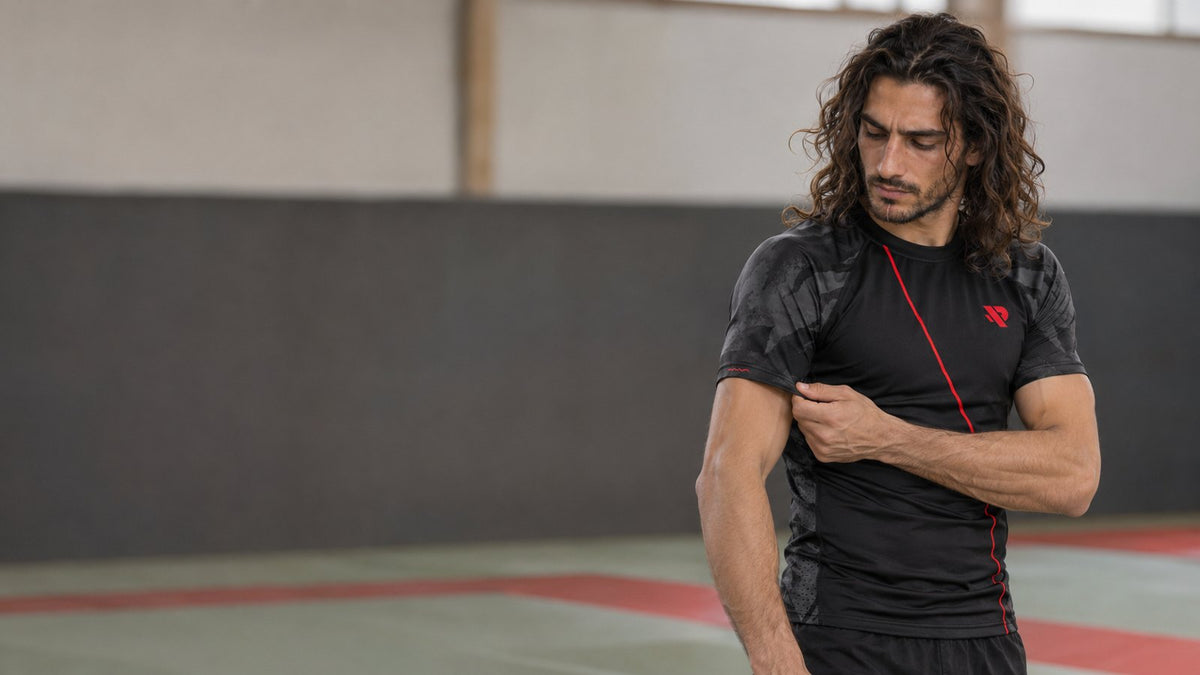
Minimal Red LineIBJJF no-gi competitor. A compliant rash guard: black or white base with at least 10% of your belt color, plus 1 or 2 training tops.
Train in the gi. 1 short or long sleeve rash guard, any color, worn under the jacket. In IBJJF, it's mandatory for women and forbidden for men.
Snowy Owl3+ sessions a week. 2 to 3 rash guards in rotation: each one gets time to air dry.
Minimal Red Line| Your profile | What we recommend |
|---|---|
| Starting out in no-gi | 1 long sleeve rash guard for training, whichever design you like |
| IBJJF no-gi competitor | A compliant rash guard: black or white base with at least 10% of your belt color, plus 1 or 2 training tops |
| Train in the gi | 1 short or long sleeve rash guard, any color, worn under the jacket. In IBJJF, it's mandatory for women and forbidden for men |
| 3+ sessions a week | 2 to 3 rash guards in rotation: each one gets time to air dry |
Every model built for the mat is in the BJJ rash guard collection.
The 2 look alike on a hanger, not on the mat. The rash guard is the combat piece, illustrated across the whole surface. The compression shirt is a plain, understated base, for the gym, strength training, or under another outfit.
Drawn from the SHIAI guides "What is a rash guard" and "Can you run in a rash guard?".
The full detail is in our guides what is a rash guard and can you run in a rash guard. See also the compression shirts.
A well-cared-for rash guard lasts years of training. Heat is its number 1 enemy: it wears out the elastane.
From 3 sessions a week on, keep 2 to 3 rash guards in rotation: each one gets time to air dry.
Out of the bag as soon as the session ends, inside out, at 30°C max, no fabric softener, air dry. The full detail is on the rash guard care page.

The best BJJ rash guard is the one you forget about during a roll. Start with 1 training top in a design you like. If you're aiming for IBJJF, add 1 ranked top in your belt color.
In IBJJF no-gi, what's the minimum share of your belt color your rash guard must show?
At least 10%, on a black, white, or black and white base. The 50% figure often mentioned isn't actually in the rulebook. A top entirely in your rank color is also accepted.
Which print stretches with the fabric without cracking or peeling?
Print in the fiber: the ink turns to gas and enters the polyester fiber before the seams are sewn. Transfer and flocking stay glued on top.
In IBJJF, under the gi jacket, the rash guard is…
Mandatory for women, with no color rule, and forbidden for men. For training, each club sets its own rule.
One that doesn't ride up. A fabric around 230 g/m², 4-way stretch, with flat seams, printed into the fiber, long enough to reach below the shorts' waistband, in your exact size.
Long sleeves protect the forearms from mat burn and make arm grips harder to lock in. Short sleeves run cooler. IBJJF rules accept both.
In ADCC and open-rules tournaments, yes. In IBJJF no-gi, no: you need a black or white base with at least 10% of your belt color.
At least 2 if you train several times a week: an air-dried rash guard isn't always ready the next day.
At 30°C max, inside out, no fabric softener, air dry. The full detail is on the rash guard care page. For the full outfit (shorts, spats), read our guide to grappling gear.


Rash guard, shorts, and spats: grappling gear piece by piece, and what the IBJJF, ADCC, and UWW rulebooks require.
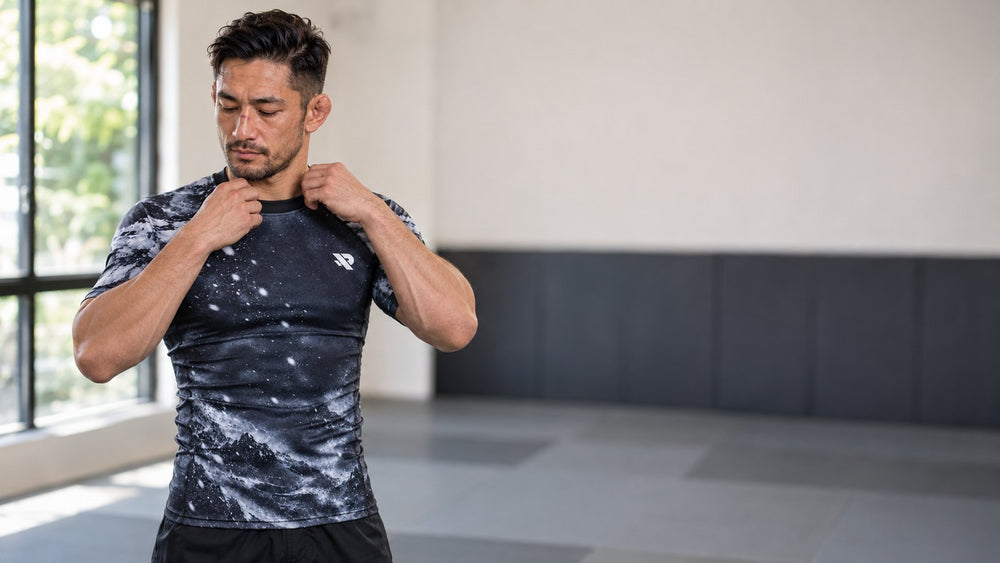
What a rash guard is for, what it's made of, and how to choose one: BJJ, grappling, MMA.
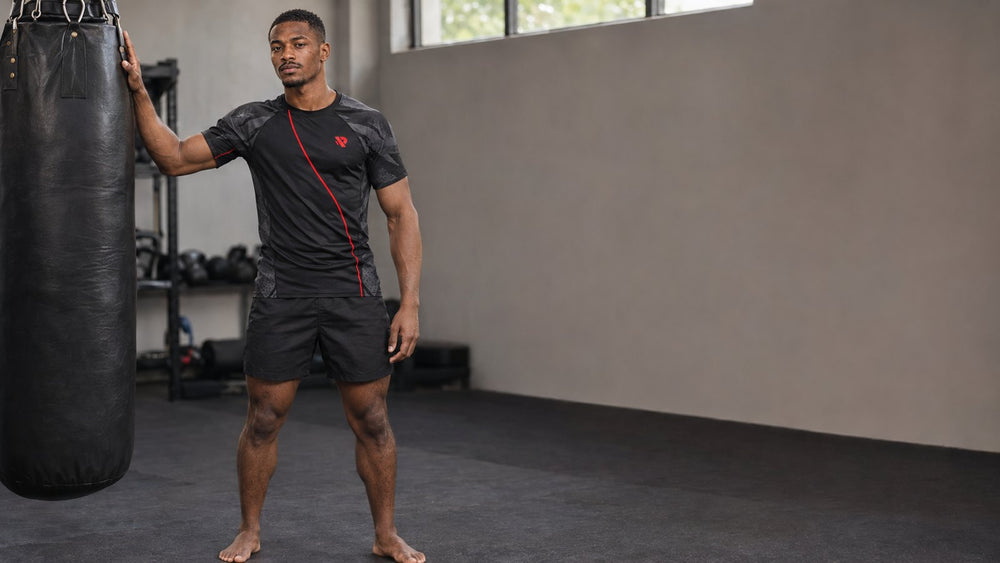
Skin, hygiene, training partners, movement, and rules: 5 concrete reasons to wear a rash guard in BJJ, grappling, and MMA.
Rashu uses analytics and advertising cookies. You can accept or decline them. Learn more
 Clan Banners Short-Sleeve Rash Guard - Men
 Hexagon Short-Sleeve Rash Guard - Men
 Hexagon Long-Sleeve Rash Guard - Men
 Urban Graphite Camo Short-Sleeve Rash Guard - Men